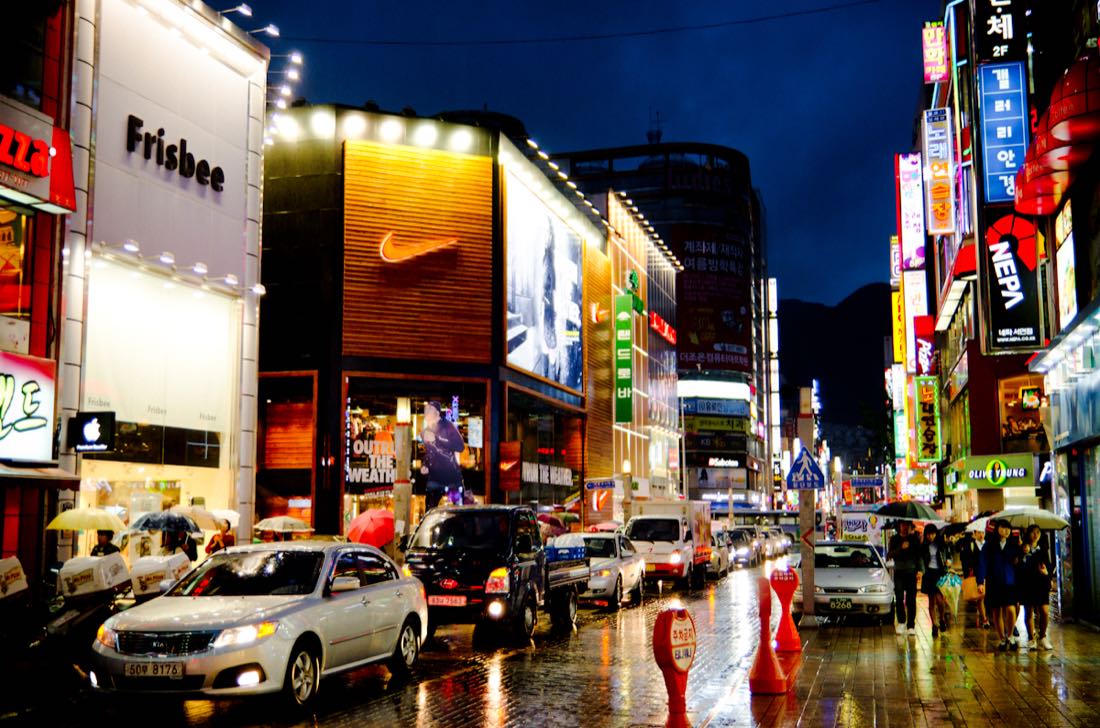
Seomyeon: the ugly base
that wins on arithmetic
Seomyeon (서면) is the only place in Busan where Line 1 and Line 2 cross, which makes it the city's hinge: about 25 minutes to Gwangalli, 40 to Haeundae, 20 to Nampo — no single commute over 40 minutes on the whole ribbon. Hotels run around ₩100,000 (~$70) a night, the food scene under the neon is real, and Jeonpo's café streets — Korea's serious coffee quarter — start one station away. It's a canyon of signage, not a postcard. That's the trade, and for the right itinerary it's a steal.
Is Seomyeon your base?
Who it suitsThe crossroads under the neon
What it isSeomyeon is downtown Busan the way locals mean it: department stores, a food-alley grid that runs to 02:00, the medical-district signage of Seomyeon Medical Street — a strip of cosmetic and dermatology clinics that's its own small tourism economy — and above it all, hotels that quietly undercut the beaches at around ₩100,000 (~$70). No sea, no hills, no hanok lane. What it has is the map: the only Line 1 + Line 2 interchange in the city.
Busan is not a city with a centre. It is a 40 km ribbon of separate towns wrapped around a coastline and cut apart by mountains — Haeundae to Gamcheon is about an hour each way, every time. The #1 planning mistake is booking the famous beach and then commuting daily to the postcard sights on the opposite side of the city. Seomyeon is the exception that proves it: sleep at the hinge and the ribbon folds in half. Gamcheon day? Line 1 west, about 45 minutes all-in. Beach evening? Line 2 east, 25 minutes to Gwangan. You trade the sea view for never sitting on the metro longer than 40 minutes — on a packed 3-day trip, that's hours back.
One station east, Jeonpo's café streets have turned old tool-shop blocks into the densest specialty-coffee quarter in Korea — a cappuccino runs about ₩5,000 (~$3.50) — and Busan's coffee credentials are real: Momos Coffee's Jeon Joo-yeon won the 2019 World Barista Championship, the first Korean ever to take it. The full case is at Busan's café scene.
Seomyeon, practically
Plan your baseStaying in Seomyeon
Book the crossroadsThe stock here is business hotels — clean, new-ish, uncomplicated. At around ₩100,000 a night, the savings fund your food budget.
Seomyeon questions, answered
FAQPage schema pairedIs Seomyeon a good place to stay in Busan?
If your itinerary covers both ends of the city or budget leads, it's the smartest base there is: hotels around ₩100,000 (~$70) at the only Line 1 + 2 interchange, with nothing further than about 40 minutes away. If the trip is beach-first, book Gwangalli instead — Seomyeon has no sea and no skyline.
How far is Seomyeon from Haeundae Beach?
About 40 minutes door-to-door on Line 2, roughly ₩1,600–1,800 (~$1.10–1.25) on a transit card. Gwangalli is nearer at about 25 minutes, and Nampo's markets about 20 minutes down Line 1 — that spread in every direction is the entire argument for sleeping here.
Is Seomyeon good for nightlife?
It's Busan's volume play: the food-and-bar grid around the station runs until about 02:00, soju at restaurant prices of ₩4,000–6,000 (~$2.80–4.20), and the crowd is local in a way the beach strips aren't. For a view with your drink, Gwangalli's bridge-facing bars still win.
What is Seomyeon Medical Street?
A signed strip of several hundred cosmetic, dermatology and dental clinics south of the station — medical tourism is a real Seomyeon industry. If you're not here for a procedure it's just scenery, but it explains the hotel stock: lots of clean rooms around ₩100,000 built for practical stays.
Where should I eat in Seomyeon?
Start with dwaeji gukbap — Seomyeon's alleys are full of it at ₩5,500–9,000 (~$4–6.30) a bowl, and the Michelin Bib Gourmand list is dominated by exactly this dish. Then Jeonpo for coffee. The full story of Busan's signature soup: dwaeji gukbap, explained.
Is Seomyeon safe at night?
By big-city standards, yes — the busy grid stays lit and peopled until about 02:00, and Busan's violent-crime risk is low even for Korea. The practical cautions are traffic and Friday-night crowds, not safety. Solo travellers base here routinely.
Where is Jeonpo Café Street?
One station east of Seomyeon on Line 2: old tool-shop blocks turned into the densest specialty-coffee quarter in Korea, with a cappuccino running about ₩5,000 (~$3.50). The credentials are real — Momos Coffee's Jeon Joo-yeon won the 2019 World Barista Championship, the first Korean ever to take it. The full crawl: Busan's café scene.
Is Seomyeon a good base for a longer stay?
It's one of the two neighbourhoods we'd pick for a month-plus, alongside Gwangalli: the Line 1+2 interchange keeps every commute under about 40 minutes, and the café grid doubles as office space. Going genuinely long? Busan qualifies for the low tier of Korea's F-1-D nomad visa — an income bar of ₩52,416,000 (~$36,700) for under-35s, roughly half Seoul's. The scoop: digital nomad Busan.