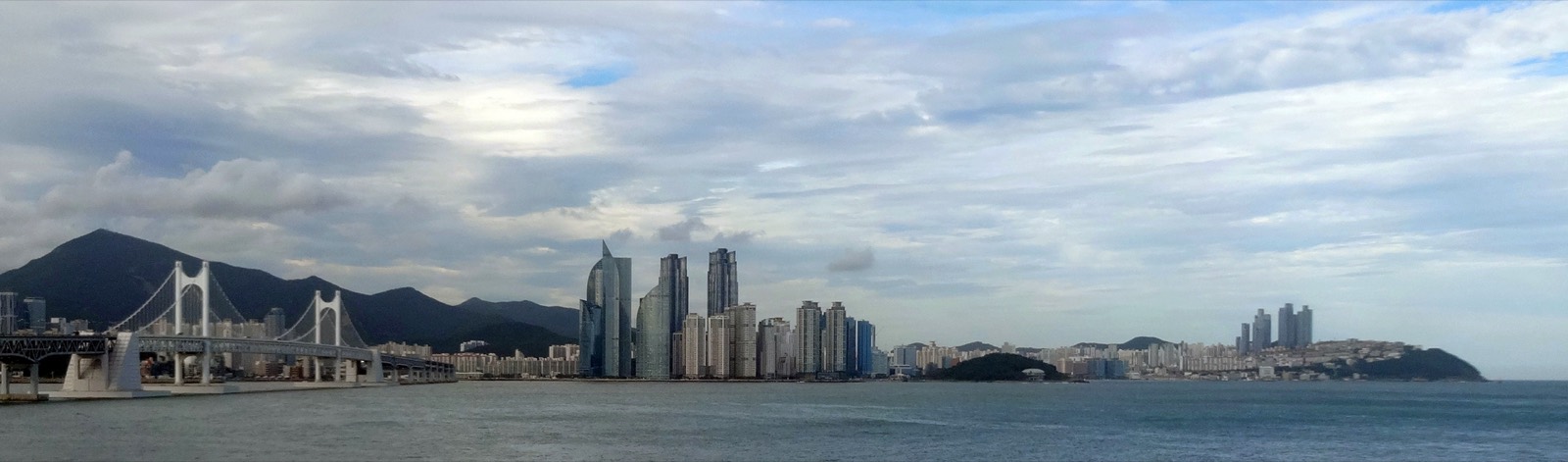
Is Busan
worth visiting?
Yes — Korea's second city earns its 3 nights, and the people who've been keep saying so. But be honest about the trip you're actually taking: the KTX from Seoul is 2h35m and ₩59,800 (~$42) each way, and on a Korea trip of under 9 days that transfer morning is expensive — 'stay in Seoul' is a legitimate answer. On 10+ days, Busan is close to automatic: a 40 km coastline of beaches, markets, temples and the best-value food scene in the country.
The numbers say go — and they're accelerating
The boom, in city dataNone of these are our estimates — they're city and Korea Tourism Organization figures for the first half of 2026.
Score yourself before you book
Who it suitsA shrinking city having the best tourism year in its history
The honest paradoxHold both of these truths and you understand Busan in 2026. The city has lost about 580,000 residents since its 1995 peak and is Korea's only super-aged metropolis — 23% of the city is over 65. It lost the 2030 World Expo bid 119 votes to 29, a rout. The Global Hub City act failed in May 2026. The new Gadeokdo airport has slipped to 2035, so little Gimhae stays the front door for this decade.
And yet the tourists keep coming in record numbers — 2.42 million foreign visitors in six months, card spend second only to Seoul, Taiwan sending more visitors here than anywhere else in Korea, US arrivals up 80% year-on-year in May alone. The city that Korean demographics wrote off is the one foreign travellers are discovering. That tension is why Busan feels the way it does: old markets and new towers, ajummas and influencers sharing the same alleys. It's also why prices haven't caught up with Seoul — the value window is open now. If you're tempted to stay longer than a holiday, the new F-1-D nomad visa sets Busan's income bar at roughly half of Seoul's.
What travellers actually say — for and against
Both sides, quotedPulled from the 2026 Reddit and TripAdvisor threads where this exact question got argued to death — about 330 comments across six threads in June and July alone. We quote both directions; you decide which traveller you are.
| The take | Our read | Verdict |
|---|---|---|
| “Busan is always worth it. A.L.W.A.Y.S.” — the thread's top answer | The majority position, and the one repeat visitors hold hardest. | WORTH IT |
| “The cooler cousin of Seoul” · “feels like a Raw Seoul” | Accurate — rougher edges, better coastline, lower bills. The full comparison is at Busan vs Seoul. | FAIR |
| “You're swimming in water that's Korea's largest export terminal” | The most-repeated criticism, and it's real. The most-repeated criticism of Busan's beaches is the port: you are swimming in the water of Korea's largest export terminal. Water quality is monitored and the beaches pass, but if pristine water is the point of your trip, Busan's beaches are city beaches — treat them as scenery with swimming attached, not the other way round. | FAIR |
| “More a place you go from attraction to attraction — at least a 30 min drive between each one” | True if you book the wrong base. The city is a 40 km ribbon; pick your end deliberately and most days stay local. | SOLVABLE |
| “6 days is far too many” | Also true. Three nights is the modal answer; past five you repeat yourself — the full maths is at how many days. | FAIR |
Quotes lightly trimmed for length, sentiment untouched. The pattern across all six threads: nobody regrets going — people only regret the ratio.
Turn the verdict into a trip
If the answer is yesTwo links cover 90% of the booking work: a bed on the right end of the ribbon, and the day tours for anything you'd rather not solve with a metro map.
Is Busan worth it — the follow-ups
FAQPage schema pairedIs Busan worth it on a 7 to 10 day Korea trip?
At 9–10 days, yes: 3 nights in Busan is the consensus shape, often with a Gyeongju day folded in. At 7–8 days it's a genuine judgment call — you'd be trading two Seoul days plus a 2h35m transfer each way. The honest tiebreaker: if food and coastline excite you more than palaces and museums, make the trade.
Is Busan a day trip from Seoul?
Physically yes — the KTX runs 2h35m each way and ₩119,600 (~$84) return — but you'd spend 5+ hours of a 14-hour day on trains for a city built around slow mornings at markets and beaches. If a day is truly all you have, do it deliberately: one side of the city only.
What is Busan famous for?
Korea's biggest port and second city: 7 city beaches along a 40 km coast, the Jagalchi fish market, Gamcheon's painted terraces, a Saturday-night drone show, Asia's biggest film festival each September, and dwaeji gukbap — the pork soup you can eat brilliantly for ₩5,500–9,000 (~$4–6.30). The full ranked list is at things to do.
Is Busan safe?
Yes — violent crime risk is low even by Korean standards, and solo travellers routinely rank it among Asia's most relaxed big cities. The real risks are seasonal: July averages 327 mm of rain, August 2026 hit a record 38.8°C, and typhoon season peaks late August–September. Watch the forecast, not your back.
Is Busan cheaper than Seoul?
For the things travellers buy, clearly: restaurants run about 23.8% cheaper than Seoul and rents about 71.7% cheaper, which flows into hotel rates. Two honest exceptions from the same data: groceries cost 7.4% more here, and the monthly transit pass is ₩80,000 (~$56) against Seoul's ₩63,500 (~$44). Line by line: Busan vs Seoul.
Is Busan worth visiting in winter?
More than any other Korean city — it's the country's mildest major city, with January highs of 8.2°C against Seoul's 2.1°C, and December–February are the driest months of the year (34–50 mm). You lose the beaches, keep the food, views and the drone show, and hotel prices soften. Details by month: best time to visit.
Where do BTS fans go in Busan?
Gwangalli — Jimin and Jungkook are hometown boys, and when BTS played 'Arirang IN Busan' on 12–13 June 2026, foreign foot traffic citywide rose +342% while Gwangalli's alone went +650%. Seomyeon-Jeonpo (+190% the same weekend) is the secondary stop. If the pilgrimage is part of your trip, base yourself on the beach the fandom chose: the Gwangalli page.
Is Busan worth visiting just for the food?
It's the strongest single reason to come: the 2026 Michelin guide lists 55 places including 4 stars and 20 Bib Gourmands — and the Bibs are dominated by dwaeji gukbap at ₩5,500–9,000 (~$4–6.30) a bowl, not tasting menus. A genuinely good eating day runs ₩25,000–40,000 (~$17.50–28) at markets, ₩60,000–100,000 (~$42–70) if you stretch. The refugee-cuisine story behind it all: the food case for Busan.