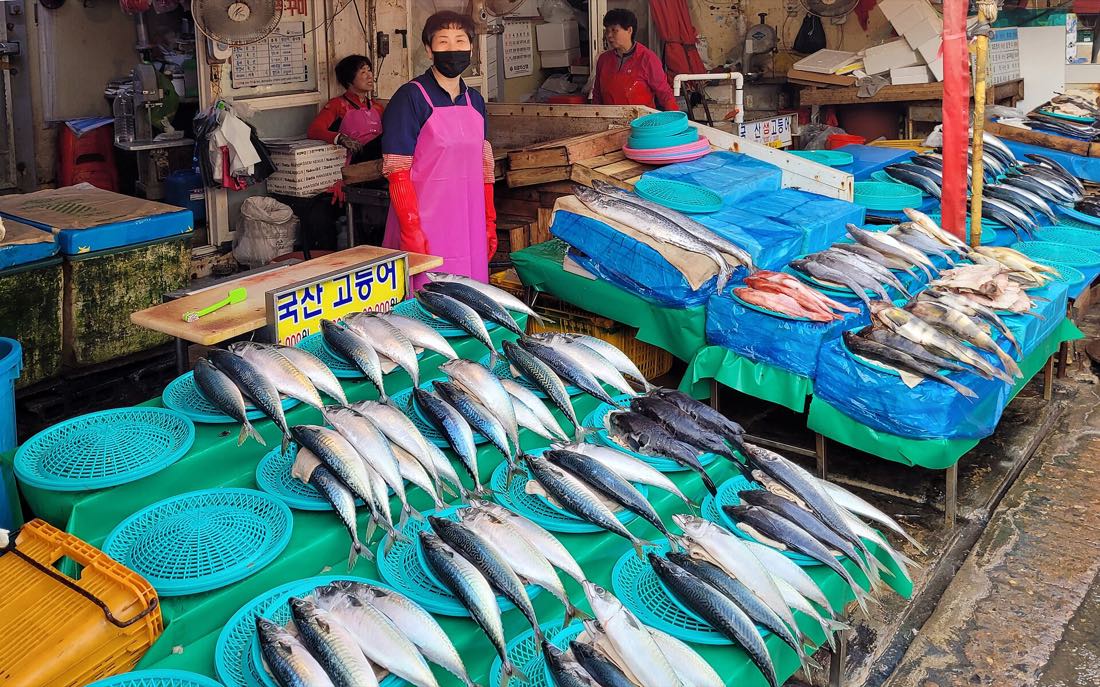
Jagalchi Market:
go to eat, not to browse.
Korea's largest fish market rates 3.9★ across 1,751 TripAdvisor reviews — the second-lowest of any famous Busan sight — and the low scores nearly all describe the same visit: wandering the wet floor, photographing tanks, being quoted startling prices, leaving hungry. Go instead as a diner with the system learned: pick your fish downstairs, agree the price before anything leaves the tank, eat it upstairs, and know the ~₩5,000 (~$3.50) per-person table charge is coming. Done that way, ₩30,000–50,000 (~$21–35) a head buys one of Korea's great lunches.
Is Jagalchi for you?
Who it suitsA working market with a restaurant on top
What it isJagalchi is where Busan's fishing fleet lands its catch and where the haenyeo-generation market women — the ajummas who run the stalls — have sold it for seventy years. The main building's ground floor is tanks and crushed ice; the first floor up is a row of restaurants that will cook whatever you carried up. That vertical move — buy downstairs, eat upstairs — is the entire institution, and visiting without using it is like touring a cinema lobby.
The famous warning — “the haenyeo halmeonis will try to rip you off” — is real Reddit, and worth taking seriously without the sneer: nothing here has price tags, quotes flex with the customer, and confusion is expensive. The fix isn't avoidance, it's procedure: point at the actual fish, get the price for that fish in writing or on a calculator, agree it before the net comes out, and confirm whether the upstairs cooking fee is included or separate. Nobody haggles hard here — you're just closing the ambiguity that overcharging lives in.
And the one everyone learns at the till: the 상차림비 (sangcharimbi), a ~₩5,000 per person table-setting charge for the banchan, lettuce, sauces and service upstairs. It's legitimate and universal — the surprise, not the fee, is what sours reviews. Budget it from the start and the bill reads exactly as quoted.
What to eat at Jagalchi, priced
Order like you've been beforeEvery price on this page was checked on 6 August 2026 against official or primary sources. Korean attraction prices move fast and sources disagree; where we couldn't verify a number, we say so instead of guessing.
| Dish | Budget | The move |
|---|---|---|
| Hoe (회) — raw fish spread | ₩30,000–50,000 (~$21–35) per person, all-in | The headline act: pick the fish, eat it sliced over an hour with soju. The all-in figure includes the ~₩5,000pp table charge |
| Kkomjangeo (꼼장어) — hagfish | From ₩60,000 (~$42) per portion, shared | The Busan classic, grilled in spicy sauce at the stalls around the market — order one portion between two |
| Grilled fish set, upstairs | Roughly ₩15,000–20,000 (~$10.50–14) per person | The lower-commitment lunch — point at the day's fish and let the restaurant handle it |
| Dwaeji gukbap, nearby | ₩5,500–9,000 (~$4–6) | The honest budget swap: skip the spread, walk the hall for free, and eat Busan's signature pork soup a few streets over |
Prices move with the catch and the season — treat these as planning bands, not menus. The ajummas respect a customer who knows the bands.
The Jagalchi day, hour by hour
Time it rightThe market runs on a working rhythm, not a tourist one. Watch where the ajummas queue for their own lunch — that's the quality signal no app has.
Prime buying window — pick your fish now, beat the lunch rush upstairs.
The practical bit
Plan your visitJagalchi, guided
Bring a translator with opinionsThis is the one attraction in Busan where a guide changes the economics: they order in Korean, know the fair bands, and the table charge stops being a surprise on your bill.
Jagalchi questions, answered
FAQPage schema pairedIs Jagalchi Market a tourist trap?
No — it's a working wholesale-and-retail market that punishes aimlessness. The 3.9★ TripAdvisor score comes overwhelmingly from browsers; diners who pick their fish, agree the price first and expect the ~₩5,000 (~$3.50) table charge report a different place entirely. The trap isn't the market, it's arriving without the system.
How much does it cost to eat at Jagalchi?
Plan ₩30,000–50,000 (~$21–35) per person, all-in, for the classic raw-fish spread — fish, cooking, banchan and the ~₩5,000 per-person table charge included. A grilled-fish lunch runs closer to ₩15,000–20,000, and kkomjangeo starts around ₩60,000 a shared portion at the stalls outside.
What is the table charge at Jagalchi?
The 상차림비 (sangcharimbi): about ₩5,000 (~$3.50) per person, charged by the upstairs restaurants for the table setting — banchan, lettuce, sauces, service. Every table pays it, Korean or foreign. It's the single most common 'hidden fee' complaint in reviews, and it stops being one the moment you budget it.
Do they take credit cards at Jagalchi?
Assume no. Traditional markets are exactly where foreign cards fail in Korea — convenience stores and hotels, fine; market stalls, no. Bring ₩50,000–100,000 (~$35–70) in cash for a proper meal; there are ATMs around Nampo, and the full money briefing is at money in Busan.
How do I avoid being overcharged at Jagalchi?
Procedure, not suspicion: point at the specific fish, get its price on a calculator before it's netted, confirm whether the upstairs cooking fee is included, and know the fair band (₩30,000–50,000 a head, all-in). Ambiguity is where the overcharge lives; close it in the first 2 minutes and the rest is just lunch.
When is Jagalchi Market closed?
The main building generally rests on the 1st and 3rd Tuesdays of the month — some outdoor stalls trade anyway, but don't plan the big meal for those days. Otherwise it runs roughly 05:00–22:00, with the best eating windows at 11:00 and 17:00.
What should I order at Jagalchi?
First visit: hoe — the raw-fish spread — chosen live from the tanks, ₩30,000–50,000 a head all-in, eaten slowly with soju (₩4,000–6,000 (~$3–4) a bottle upstairs). Second visit, or braver: kkomjangeo, the grilled hagfish that's a Busan signature. The full canon of what this city eats is at Busan food, decided.